

By Bret Yager
What can your grip strength reveal about your health and longevity prospects? A lot more than is commonly realized, say App State researchers Dr. Jeff McBride and Dr. Andrew Shanely, professors in the Department of Kinesiology.
With the help of four graduate students, the duo is gathering data from dozens of test subjects as part of a multi-year study aimed at bolstering an emerging body of science linking strength training to longer lifespans and grip strength as a key indicator for whole-body muscular health.
Graduate assistant Daniel Williams leads the research team for the study, named Physical Outcomes With Exercise Related to Functional Utility and Longevity (POWERFUL). With team co-lead Haley O’Donnell, also a graduate assistant in the Department of Kinesiology, Williams facilitates a lineup of strength testing sessions, data collection and analysis, site visits and subject recruitment.
“This work has given me the opportunity to gain hands-on experience conducting applied human performance research across a diverse range of people,” he says. “I hope POWERFUL will improve lives by encouraging strength training as an integral part of health.”
After years of study and numerous published papers, McBride and Shanely believe there is evidence to warrant a clear health message they hope doctors will take up and amplify: Weight lifting and other strength-building exercise is not just for athletes—it increases disease resilience and decreases fall-risk and related injuries—among a multitude of benefits—and should be integrated with public health recommendations alongside aerobic exercise.
“Mounting evidence points to muscle strength as a key predictor of overall health and longevity,” Shanely says.
McBride says there is also enough evidence that medical professionals should add grip strength as a fifth vital sign, joining blood pressure, pulse rate, temperature and breathing rate during routine physical exams.
“Recent research by other laboratories has shown that handgrip strength is an indicator of longevity and the incidence of disease such as cardiovascular disease, COPD, respiratory disease and cancer,” says McBride, who directs the Neuromuscular & Biomechanics Laboratory in Levine Hall of Health Sciences.
“In some instances, handgrip strength has been shown to be an even better predictor of mortality than blood pressure,” McBride says.
The POWERFUL study, now in its second year, has 67 subjects aged 18 to 93, and the research team will continue recruiting more participants on a rolling basis, documenting how the link between whole-body strength, grip strength, longevity and morbidity play out over time.
(Header photo: App State’s POWERFUL research team, from left, Dr. Andrew Shanely, graduate student Daniel Williams, Dr. Jeffrey McBride and graduate student Haley O’Donnell use the Neuromuscular & Biomechanics Laboratory in the Levine Hall of Health Sciences for a study linking whole-body strength to longevity and grip strength as a key indicator of whole-body strength—with a goal of bolstering science that could lead to better recognition within the medical field of these connections. Photo by Kyla Willoughby)
Mountaineer Discovery: This story is part of a series highlighting student research, creativity and innovation at App State. Join the Office of Student Research for the 29th annual Celebration of Student Research and Creative Endeavors on Wednesday, April 22.
Woman squeezes a grip measurement device while a younger woman in a black App State polo holds out her hand to help
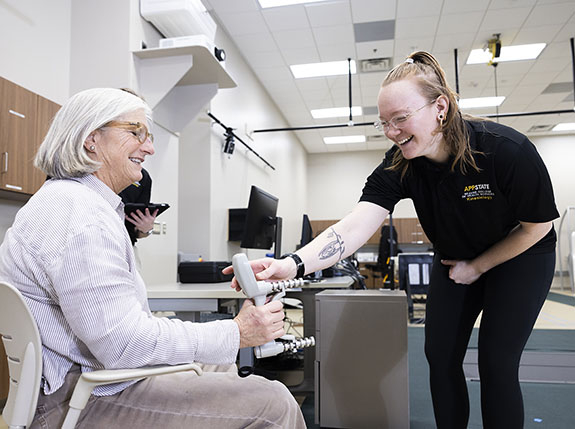
App State student researcher Haley O’Donnell, right, tests grip strength with Mary Sheryl Horine using a handgrip dynamometer. Photo by Kyla Willoughby